In an increasingly automated and data-driven world, the ability to accurately perceive and understand our surroundings is paramount. At the forefront of this revolution are advanced sensing technologies, with the Lidar Sensor and sonar playing critical, often complementary, roles. While radar has been a long-standing staple, the precision and versatility offered by modern Lidar Sensor technology, sometimes augmented by sonar, are pushing the boundaries of what’s possible, enabling everything from navigating bustling city streets in autonomous vehicles to mapping the mysterious depths of the ocean. This article delves into the diverse and impactful applications where the Lidar Sensor is making a significant difference.
The Fundamentals: Understanding the Lidar Sensor
Before exploring its applications, it’s essential to grasp what a Lidar Sensor is and how it functions. Lidar, an acronym for Light Detection and Ranging, operates on principles similar to radar but uses pulsed laser light instead of radio waves. A Lidar Sensor emits millions of laser pulses per second, measures the time it takes for these pulses to return after reflecting off objects, and then calculates the distance to those objects with remarkable precision. By rotating the laser and combining these distance measurements, a Lidar Sensor generates a highly detailed 3D point cloud of its environment, offering unparalleled spatial resolution and accuracy, enabling advanced 3d scanning capabilities.
Sonar, by contrast, uses sound waves to detect objects underwater or underground. While its resolution is typically lower than a Lidar Sensor‘s, its ability to penetrate water and certain materials makes it invaluable in specific environments where light cannot propagate effectively. Often, these two technologies are used in conjunction, creating a more robust and comprehensive perception system.
Lidar Sensor Applications in Autonomous Vehicles: The Eyes of Self-Driving Cars
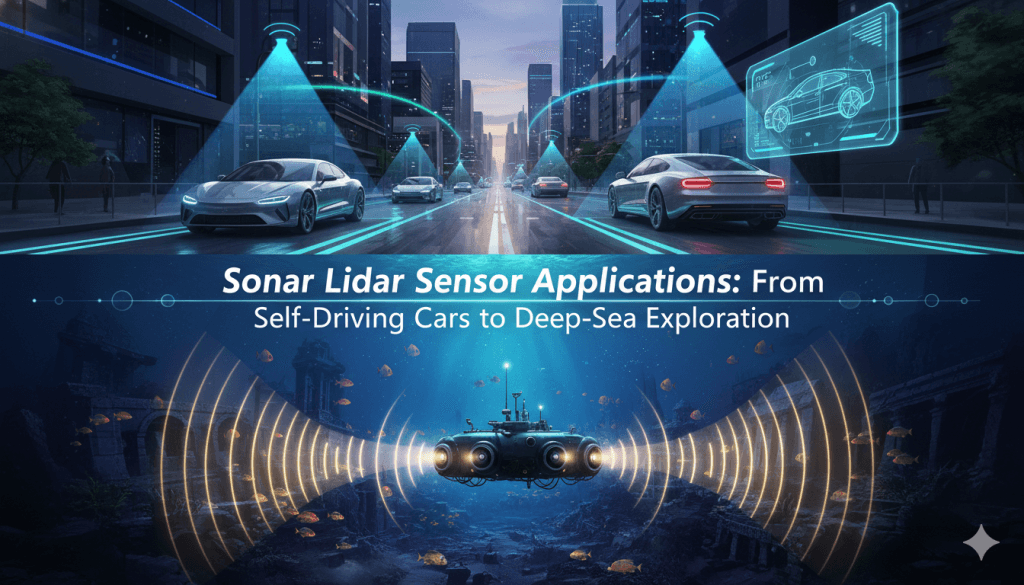
Perhaps the most recognized application of the Lidar Sensor is in the realm of autonomous vehicles (AVs). The Lidar Sensor is considered a cornerstone technology for self-driving cars, providing the critical 3D perception necessary for safe and reliable navigation.
- Real-time 3D Mapping:A Lidar Sensor continuously scans the environment around the vehicle, creating a dynamic, high-definition 3D map. This map includes detailed information about road geometry, lane markings, traffic signs, pedestrians, cyclists, and other vehicles.
- Object Detection and Tracking:The precision of a Lidar Sensor allows for the accurate detection and classification of objects, distinguishing between a pedestrian, a bicycle, or a parked car. It can track multiple objects simultaneously, predicting their trajectories to avoid collisions.
- Localization:By comparing its real-time 3D scans with pre-recorded high-definition maps, the Lidar Sensor enables the autonomous vehicle to pinpoint its exact position on the road with centimeter-level accuracy, even in GPS-denied environments like tunnels or urban canyons.
- Perception in Challenging Conditions:While performance can be affected by heavy fog or snow, a Lidar Sensor generally offers superior performance to cameras in low-light conditions and is less susceptible to glare or shadows that can confuse vision-based systems. The robustness of a Lidar Sensor in varied lighting ensures continuous environmental awareness.
The integration of multiple Lidar Sensor units, strategically placed around a vehicle (e.g., roof-mounted for a 360-degree view, and fender-mounted for short-range obstacle detection), creates a redundant and comprehensive perception layer, vital for achieving Level 4 and Level 5 autonomy.
Lidar Sensor in Robotics and Industrial Automation
Beyond autonomous cars, the Lidar Sensor is transforming the landscape of robotics and industrial automation, enabling robots to operate more intelligently and safely alongside humans.
- Mobile Robot Navigation:In warehouses, factories, and logistics centers, mobile robots equipped with a Lidar Sensor navigate complex environments, avoiding obstacles, optimizing routes, and performing tasks like inventory management or material transport.
- Safety and Collision Avoidance:Industrial robots often work in close proximity to human operators. A Lidar Sensor provides critical safety functions by establishing virtual safety zones and immediately stopping robot operations if a human enters a hazardous area.
- Precision Manufacturing: A highly accurate Lidar Sensor can be used for quality control, performing precise measurements of manufactured parts, detecting defects, and ensuring products meet strict specifications. This is crucial for industries like automotive, aerospace, and electronics.
- Automated Guided Vehicles (AGVs): Forklifts and other AGVs use a Lidar Sensor for reliable and efficient path planning and obstacle avoidance, improving operational efficiency and reducing accidents in industrial settings.
Lidar Sensor for Environmental Mapping and Surveying
The ability of a Lidar Sensorto create detailed 3D maps extends far beyond urban roads, making it an invaluable tool for environmental monitoring and large-scale surveying.
- Topographic Mapping: Aerial Lidar Sensor systems mounted on aircraft, drones, and UAVs can rapidly scan vast areas, generating highly accurate digital elevation models (DEMs) and digital surface models (DSMs). This data is vital for urban planning, infrastructure development, and flood plain mapping.
- Forestry and Agriculture: A Lidar Sensorcan penetrate forest canopies to map ground topography, measure tree heights, estimate biomass, and assess forest health. In agriculture, it can be used for precision farming, mapping crop density, and identifying areas requiring targeted irrigation or fertilization.
- Archaeology and Cultural Heritage: By effectively “seeing through” dense vegetation, an aerial Lidar Sensor has uncovered ancient ruins and lost cities previously hidden from view, providing invaluable insights into past civilizations without destructive excavation.
- Coastal Zone Management: A specialized bathymetric Lidar Sensor uses green laser light that can penetrate water to map shallow ocean floors, shorelines, and coastal erosion patterns, assisting in environmental protection and disaster preparedness.
Deep-Sea Exploration: The Role of Sonar (and future Lidar Sensor possibilities)
While a traditional Lidar Sensor struggles in water due to rapid light absorption, the principles of active ranging are still crucial for deep-sea exploration, where sonar reigns supreme.
- Underwater Mapping and Navigation: Sonar systems are the primary tools for mapping the seafloor, identifying underwater geological features, shipwrecks, and marine habitats. Autonomous Underwater Vehicles (AUVs) rely heavily on sonar for navigation, obstacle avoidance, and mission execution in environments where GPS is unavailable.
- Object Detection and Imaging: Side-scan sonar creates detailed acoustic images of the seafloor, revealing submerged objects. Multibeam sonar generates high-resolution 3D bathymetric maps, providing vital data for scientific research, offshore construction, and resource exploration.
- Future Lidar Sensor Potential: Although currently limited, research is ongoing to develop specialized underwater Lidar Sensor systems using blue-green lasers that can penetrate water over shorter ranges. These could provide higher resolution imagery than sonar for close-up inspections of underwater structures, pipelines, or biological samples, complementing the broader mapping capabilities of sonar. The challenge remains to overcome the significant attenuation of light in water, but advancements in laser power and sensor sensitivity could lead to niche applications for an underwater Lidar Sensor.
Bridging the Gap: Sonar and Lidar Sensor Synergy
In many advanced systems, the optimal solution involves combining both sonar and Lidar Sensor technologies.
- Autonomous Driving Redundancy: Some autonomous vehicles may use ultra-sonic (sonar) sensors for very short-range obstacle detection, especially in parking scenarios or for blind-spot monitoring, complementing the long-range, high-resolution data from the Lidar Sensor.
- Integrated Robotics: A robot designed for both terrestrial and aquatic environments might seamlessly switch between a Lidar Sensor(on land) and sonar (underwater) for environmental perception, providing a truly versatile operational capability.
- Complex Environmental Monitoring: For mapping projects involving both land and shallow water, a combination of aerial Lidar Sensor and bathymetric sonar provides a complete, uninterrupted 3D model of the terrain.
The combined strengths of the Lidar Sensor‘s precision in air and sonar’s penetration in water create a powerful toolkit for understanding our world, from its highest peaks to its deepest trenches.
Conclusion
The applications of the Lidar Sensor are profoundly impacting numerous industries, ranging from the revolutionary advancements in self-driving cars and robotics to detailed environmental mapping and archaeological discovery. Its ability to generate highly accurate 3D representations of complex environments has made it an indispensable component in the quest for greater autonomy, efficiency, and safety. As technology continues to evolve, we can expect the Lidar Sensor to become even more pervasive, driving innovation across an even broader spectrum of applications.
When sourcing critical components like high-quality lasers and light sources that power these sophisticated sensors, reliability and precision are paramount. Companies like INPHENIX stand out as world-class manufacturers of high-quality sensor devices. Their dedication to producing advanced photonics components ensures that systems relying on a Lidar Sensor can perform at their peak. Furthermore, INPHENIX is known for its professional after-sales service, providing expert support and technical assistance long after the initial purchase, guaranteeing the longevity and optimal performance of their devices within your cutting-edge applications.