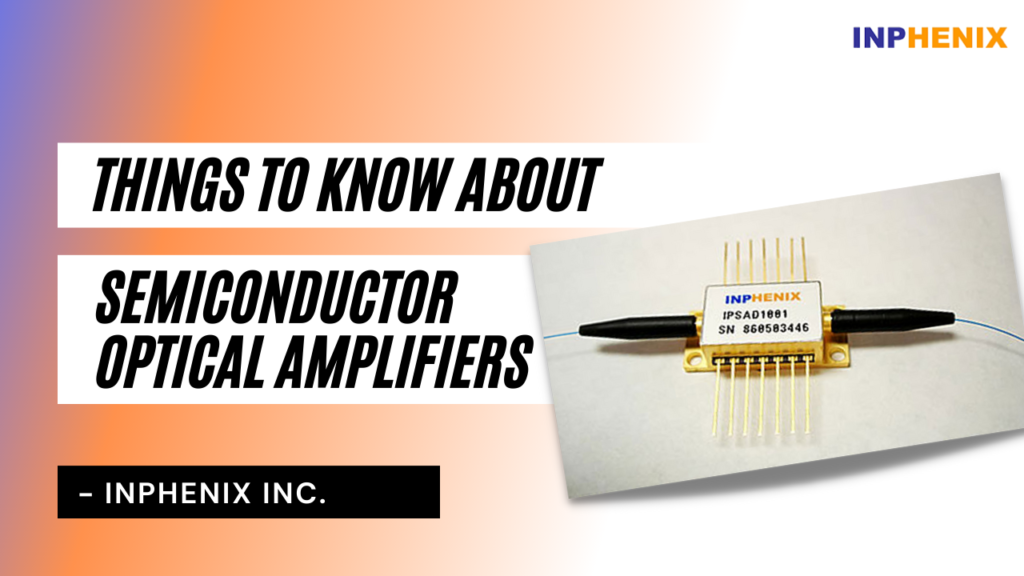
Semiconductor Optical Amplifiers are essentially electronic components leveraged in telecommunication to compensate for the loss of signal. SOAs work on the basis of a gain medium; in layman’s terms, they help in “gaining” the lost signal input and ensure complete delivery of the signal.
A semiconductor optical amplifier can be thought of as a laser diode, but with both ends covered by non-reflecting coatings. There are certain parameters upon which SOA works, such as:
- Selectable wavelengths such as 1310nm, 1400nm, 1550nm, and 1610nm.
- A gain of 20dB
- An output of up to 16dBm
- Emission of wavelength equal to the input
Semiconductor Optical Amplifiers, thus, enhance the input signal and mitigate the loss of optical devices. They work by emitting laser with wavelengths of the original input. When selecting an ideal Optical Amplifier, especially SOA, there are certain factors that you have to consider. But before that, let’s know the definition of SOAs.
Definition of a Semiconductor Optical Amplifier
Simply described, a semiconductor optical amplifier is a small electronic component that increases the intensity of light impulses passing through it. A semiconductor substance, such as gallium arsenide or indium phosphide, is used in this device to emit light. The interaction between the produced light and the received signal then amplifies the signal, allowing it to travel farther without losing power. This process is facilitated by the semiconductor’s ability to provide optical gain, which compensates for signal attenuation over long distances. The amplifier is commonly used in optical communication systems to boost signal strength and extend the reach of data transmission.
How Do Semiconductor Optical Amplifiers Work?
A semiconductor laser is equipped with a feedback mechanism and helps in transmission. The working of the Semiconductor Optical Amplifier (SOA) is similar but with the absence of a feedback mechanism. A laser is responsible for emitting photons that are a result of excited electrons due to the input signal. These photons, in turn, carry forward as the optical signal.
In SOA, a semiconductor amplifier excites these electrons from their ground state to stimulate photons with the same wavelength as the original input, thus creating an amplified optical signal. Unlike a laser, which requires a feedback loop to sustain lasing, the SOA relies on the stimulated emission of photons to amplify the incoming optical signal. This process enhances the signal’s strength, making it suitable for applications in optical communication where signal boosting is necessary.
Semiconductor Optical Amplifiers are often compared with EDFA (Erbium Doped Fiber Amplifier), however, both are different in regard to performance. In order to understand the application, we will first take a look at the four key parameters of consideration when selecting SOAs.
Importance of Semiconductor Optical Amplifiers
It is impossible to overstate the significance of semiconductor optical amplifiers, which have revolutionized the telecommunications industry by enabling the efficient and rapid transmission of enormous volumes of data across long distances. Also, they are used in a wide variety of other industries, such as sensing, spectroscopy, and imaging in the medical profession, to mention a few.
Semiconductor optical amplifiers continue to advance optoelectronics research and have an impact on the modern world thanks to their extraordinary abilities.
Construction of Semiconductor Optical Amplifiers
In semiconductor optical amplifiers, gain regions—thin strips of a semiconductor material doped with impurities to permit optical amplification—are frequently found sandwiched between two cladding layers made of a different semiconductor material. These cladding layers are engineered to confine the optical field within the gain region, ensuring efficient amplification of the light passing through. Only in the gain region, where the cladding layers are designed to keep light with the semiconductor material and be amplified, does the optical gain occur.
Additionally, the design of the semiconductor optical amplifier may include a waveguide to direct the light through the gain region, a current source to provide the necessary electrical excitation, and a heat sink to manage the thermal load generated during operation. These components work together to enhance the performance and stability of the optical amplifier.
A Detailed Description of Their Physical Structure
The physical design of Semiconductor Optical Amplifiers (SOAs) is tuned to maximize the interaction between light and the semiconductor material, allowing for effective optical signal amplification. An SOA’s fundamental framework often consists of:
- Gain region: To enable optical amplification, an impurity such as erbium or ytterbium is doped into a narrow strip of semiconductor material, such as gallium arsenide or indium phosphide.
- Cladding layers: Two layers of semiconductor material, called cladding layers, are used to confine light to the gain region so that it can interact with the semiconductor material and be amplified. Cladding layers have a lower refractive index than the gain region.
- Waveguide: A device’s internal framework that directs light through the system and enables interaction with the gain region. The waveguide could be a separate part of the device or it might be integrated into the cladding layers. It is designed to confine and guide the optical signal with minimal loss, ensuring efficient interaction between the light and the gain medium. This structure typically has precise dimensions and materials to optimize performance and maintain signal integrity.
- Current source: A component that propels the injection of current into the gain region, which causes the semiconductor material to emit and elaborate light, is known as a current source.
- Heat sink: A heat sink is a part that distributes the heat produced by the device, protecting the semiconductor material and maintaining device performance.
Depending on its intended function and the particular semiconductor material employed, an SOA’s physical structure can change. To enable effective amplification of optical signals, the semiconductor optical amplifier’s fundamental design has been enhanced to maximize light-semiconductor interaction in the gain area.
Advantages and Limitations of SOAs
Semiconductor optical amplifiers (SOAs) have several advantages and limitations that make them valuable tools in optoelectronics. Here are some of the key advantages and limitations of SOAs:
Advantages:
- Optical signals can be amplified effectively thanks to a high gain.
- Fast response time, making SOAs suitable for high-speed signal processing.
- SOAs are capable of conducting all types of non-linear operations.
- Compact size, enabling integration with other optoelectronic devices.
Limitations:
- Comparatively speaking, SOAs have a lower output power than other kinds of optical amplifiers.
- The boosted signal in SOAs may get distorted due to nonlinear processes.
- Temperature variations can have an impact on SOA performance because they are sensitive to them.
By being aware of their benefits and drawbacks and choosing when to apply them in a given application, engineers may maximize the performance of SOAs. To see the pros and cons of SOAs in detail, check our blog: Advantages and Disadvantages of Semiconductor Optical Amplifiers.
Future Developments in Semiconductor Optical Amplifiers
Future advancements in semiconductor optical amplifier (SOA) technology will concentrate on boosting output power, enhancing efficiency, lowering noise, and nonlinear effects. Researchers are investigating new semiconductor materials, inventive device architectures, and hybrid integration with other optical components to achieve these goals.
Moreover, ongoing work aims to create SOAs with greater dynamic range and improved temperature stability. These advancements could broaden their applications in high-power and high-speed optical systems. Generally, SOA technology has a promising future, with continued research and development expected to enhance its functionality and expand its range of applications.
Four Key Parameters to Consider While Selecting SOAs:
- Gain: As the word suggests, gain means to increase something. Gain is simply a ratio of output power and input power. The higher the gain, the higher the output power. SOA with higher gains is preferable as they ensure a consistent increase in the power of the output signal, meaning a less net loss of power.
- Gain Bandwidth: For transmission, bandwidth is one of the most important parameters. In reality, all the tools work unanimously to deliver a signal. For a suitable SOA, wide gain bandwidth is recommended as they can help in “gain” of a wide band of wavelengths.
- Saturation: Saturation refers to the upper limit of a power level in a transmission. Output power can only be up to its saturation point beyond which power levels are impossible. Thus, for an ideal SOA, the saturation limit should be pretty high for it to be considered standard. A low saturation SOA is not desirable as it will decrease the net “gain”.
- Noise: During the transmission and amplification, undesired signals will arise. These undesired signals are referred to as “noise”. Thus, an acceptable SOA must have low noise.
As we have seen above, Semiconductor Optical Amplifiers are often compared with EDFA (Erbium Doped Fiber Amplifier), but the performance of both is on different levels and cannot be compared because SOA is generally compact and electrically pumped, thus making it relatively cost-effective when compared with EDFA. Additionally, it works with lasers in comparatively low power.
To know the application areas of semiconductor optical amplifiers, check our blog: Scope of SOA Application Areas.
Conclusion
Finally, it should be noted that semiconductor optical amplifiers (SOAs) constitute a crucial part of contemporary optoelectronics technology. Their physical design, which includes thin semiconductor gain regions and cladding layers, is intended to enhance the interaction between light and the semiconductor material, resulting in effective optical signal amplification. The high gain, quick response times, and compact size of SOAs make them ideal for a variety of applications, including telecommunications, data centers, and fiber optic networks. Despite their drawbacks, such as potential noise and limited dynamic range, SOAs continue to propel optoelectronics advancement and influence the modern world. Their ongoing development and integration with other optical components promise further improvements and expanded use cases in the future.
Inphenix is a US-based company established in 1999, renowned for its expertise in designing and manufacturing advanced optical devices. We specialize in a wide range of products, including swept-source lasers, Fabry-Perot (FP) lasers, gain chips, distributed feedback (DFB) lasers, and vertical-cavity surface-emitting lasers (VCSELs). Our cutting-edge products are engineered to deliver high performance and reliability and are compatible with a broad variety of devices and applications across various industries. Our commitment to innovation and quality ensures that our solutions meet the evolving needs of our customers in fields such as telecommunications, biomedical imaging, and optical communications.